Enhancing mapping ICD-10 to ICD-11: an AI-based approach using BERT and LLM
As part of the WHO Mapping Task Force (at OMS), the ANS collaborates on building and validating global semantic mapping alignments, specifically transitioning between ICD-10 (CIM-10) and ICD-11 (CIM-11).
In November 2025, our poster #334 Enhancing mapping ICD-10 to ICD-11: an AI-based approach using BERT and LLM has been selected for presentation session at the WHO-FIC annual meeting.
CONTEXT of ICD-11
ICD-11 allows for a more detailed and nuanced description of diseases and conditions, thereby improving diagnostic accuracy and reflecting the most recent pathological classifications. Its richness also brings its own share of complexity when it comes to mapping from ICD-10 to ICD-11. This process requires considerable time and effort, particularly when performed manually by experts. Automated mapping is necessary to reduce this workload. In France, the transition from ICD-10 to ICD-11 for the PMSI (hospital stay tracking system) is expected to be fully implemented by 2030.
METHODS and MATERIALS for mapping with AI
DATASET : ICD10 version 2019 (14000 concepts ? )/ ICD11 version janv 2025 EN (55000 concepts)
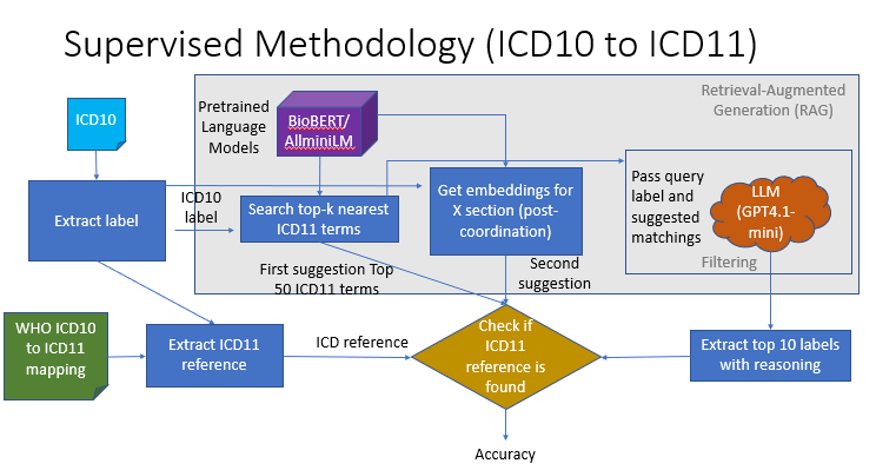
- Step 1: we extract label annotation from ICD 10 dataset and apply the Biobert 1 model pretrained with large scale biomedical corpus to search for the nearest ICD 11 terms (output: first suggestion of top 50 ICD 11 similar terms).
- Step 2: we apply all-MiniLM L6V2 sentence transformer model with contextual embeddings linked to post coordination section (output: second suggestion of top 50 ICD similar 11 terms).
- Step 3: we use LLM Gpt4.1 mini 3 improve information retrieval systems from new sources of knowledge and allows the selection of the top 10 responses with reasoning (RAG) among all retrieved.
VALIDATION
Ground truth dataset : 2025-01 ICD-11 for Mortality and Morbidity Statistics for reference of human validation https://icd.who.int/browse/2025-01/mms/en
RESULTS
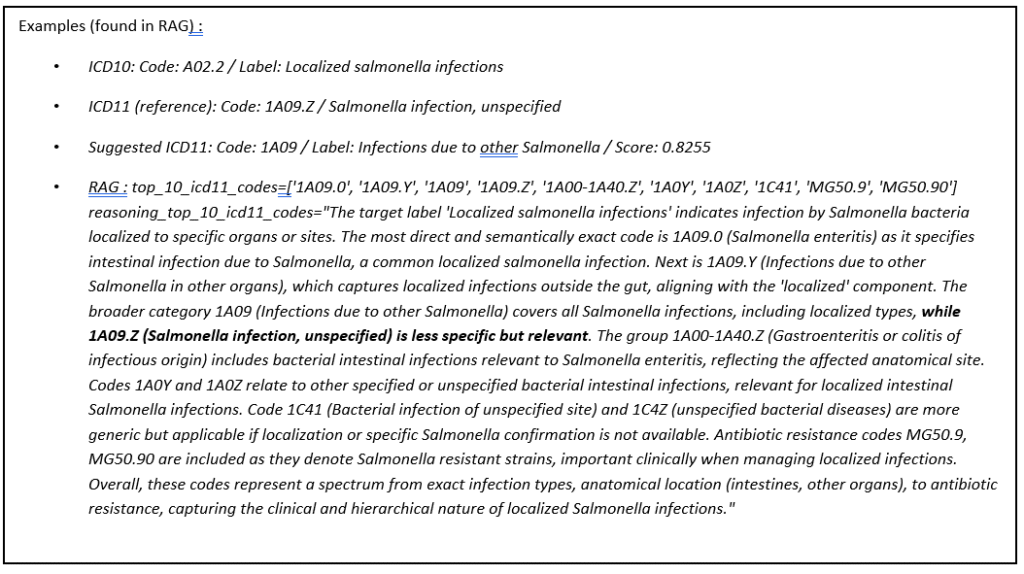
At the end, we compare ICD10- ICD 11 Ground truth dataset with Top 10 ICD11 generated with AI approach. By combining LLM/RAG with the Biobert model, it is possible to traverse RDF triples (subject → predicate → object) in a more optimized way, enabling discovery, augmentation and reasoning across knowledge graphs, and reducing the list from 50 top label to 10 labels. The alignment model achieved a mapping coverage of 82.43% across CIM-10 to CIM-11 concepts
TRANSFERABILITY TO THE FRENCH ECOSYSTEM
Since 2026 we continue with its initiative to apply the model to the French context with ICD10 PMSI (hospital stay monitoring) to ICD11 MMS ( for Mortality and Morbidity Statistics).
To evaluate the transferability of the AI pipeline developed on international ICD datasets in 2025 (hybrid approach using BERT and LLM/ RAG – OMS 2025 poster 334), we applied it directly to the French national terminologies CIM-10-FR-PMSI (19,076 concepts) and CIM-11-MMS (60,224 concepts). The model successfully suggested candidate matches for 79,82% of the concepts (82.43% with ICD international version), distributed across various confidence levels. A sampling method is defined to manually validate a subset of the matches depending on confidence threshold. The AI-generated CIM10-CIM11 is stratified into five reliability tiers, defined jointly by match type and RAG validation outcome, revealing that:
- 18.6% of correspondences achieve exact concordance with ground truth and are directly usable
- 27% exhibit high reliability through partial or hierarchical label matches, warranting expert verification prior to adoption.
- Approximately 13% of cases, classified as medium reliability, require structured validation workshops to adjudicate between AI-proposed and RAG-suggested mappings.
- The remaining 41%, lacking automated ground truth correspondence, necessitate manual expert mapping, with RAG outputs serving as auxiliary guidance.
Next step is ATIH experts validation session based on the generated AI mappings. Beyond immediate quality assurance, expert corrections can be reinjected as refined ground truth to iteratively retrain and recalibrate the mapping pipeline, progressively reducing the proportion of low-confidence mappings across successive iterations.